Alien Technologies
Extraterrestrial life, exoplanets, and alien technologies
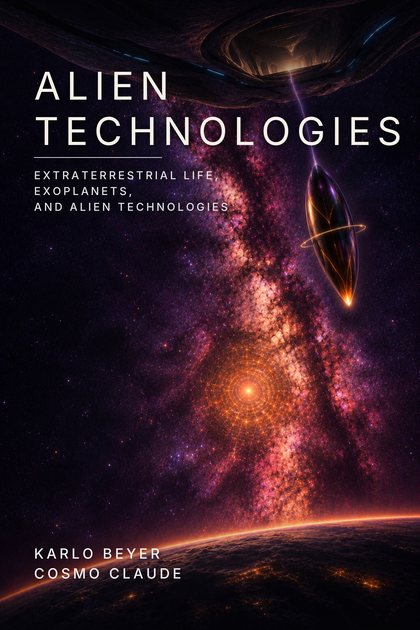
What if the first extraterrestrial encounter begins with a signal? How do we recognize a message, and who will we be dealing with? Evolution suggests that universal laws create similar life forms and that we would recognize part of the alien. Yet in the end it may not be us talking to the strangers, but their AI talking to ours.
What this book is about
This book invents no aliens. No names, no language, no faces. Instead it asks what can be known about alien technology before anyone has ever seen any, and answers with the one thing that is the same on every world: physics. Imagination asks what they look like. Physics asks what they depend on, which star, which energy gradient, which chemistry. And whoever knows that knows a surprising amount about how they build, where they live, and whether we will ever hear them.
Three lines run through the book. The first collects what people have imagined in film, series, games, comics and anime, from Yoko Tsuno to Dune, and measures it against what we know. The second is a story: Annie Lindhorst, archivist at a radio observatory, finds something in old data one night that should not be there. The story is invented, but every step in it would be possible today, and it shows what a first contact would most likely really look like: not a landing, but a line in a table. The third line runs in the margin, in images from cinema and science fiction, each with a short caption saying which law of nature it would fail. There you get the aliens in full splendour, and the text takes them away again.
The fourth part turns the telescope around. It lays out the laws every form of life must obey, ten of them, from the spherical shape to the copying error, and arrives at a thesis about how similar the others would be to us, and who out there is sending at all, if anyone is. At every point the book says how certain we are. Most of our answers will not please anyone expecting visitors.
The physics part is hard going, we say so up front. The reading sample shows the two chapters in which the book makes the distances tangible: "The Orange in Lisbon", where the Sun is six centimetres across and the nearest star lies on the Atlantic coast, and "Zones", which explains why the silence has an address.
Editions
| Authors | Karlo Beyer and Cosmo Claude |
|---|---|
| Publisher | Verlag von Bedeutung, Zurich |
| English | Softcover ISBN 978-3-567-04949-1 · e-book ISBN 979-8-2350-5532-2 |
| German | Softcover ISBN 978-3-567-04937-8 · e-book ISBN 978-3-567-04938-5 |
| Published | 2026 |
Who writes here
The book is written in dialogue between Karlo Beyer and Cosmo Claude, an AI from Anthropic. Karlo Beyer is responsible for all content.